Reflections and takeaways from the scoping trip

Since early October, the Bright-Futures team has successfully completed their month-long scoping trip to  Kerala, India.

The main objective of the scoping trip was to visit farms and gain a deeper understanding of local farming systems: their structure, challenges, and opportunities. These insights helped the PhD researchers to refine their research questions, strengthen their methodological approaches, and adapt their research instruments to the local context.

Below are reflections and key takeaways from the researchers themselves:
Hannah Melcher (Biodiversity and Ecosystem Services)

“After reading about it and hearing a lot about our study region from fellow researchers it was a valuable experience travelling to Wayanad, Kerala ourselves. Meeting so many motivated and passionate farmers, seeing these highly diverse agroforestry systems and getting in touch with local research facilities and NGOs was truly helpful for narrowing down my research question. Seeing all these diverse systems, not only on the farms themselves but also in the social networks established by farmers was very important to see, for starting to plan the fieldwork.

With all this diversity on so many levels I do see the challenge to design a study which does justice to such a diverse region, but it also provides an excellent opportunity to study a biodiversity hotspot from a socio-ecological perspective.”


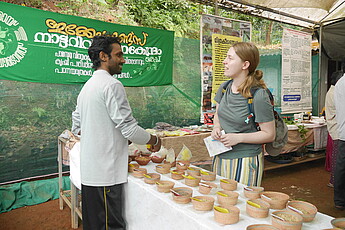
Exchanging with Amal, a local rice farmer in Wayanad, an active member of EcoFriends, and a PhD candidate in zoology at the local university.
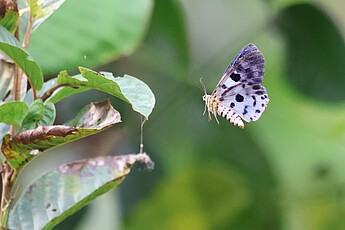
One of Hannah’s many observations on the biodiversity found on farms in Wayanad

Hannah Uther (Ecosystem Ecology)

"We started our PhD planning our research in India, searching for relevant research questions and developing a meaningful research design. We thought we knew what we could and wanted to do, but going to Kerala and especially Wayanad, seeing the farms and agroecological systems with our own eyes, we got a whole new perspective on what could and should be done. Especially talking to farmers, discussing about their personal experience, exchanging about the food system, cultivation practices and opportunities and challenges they have, was an amazing opportunity to get much deeper insight into the agricultural system and the socio-ecological interdependencies in it. Also, meeting with researchers from the Kerala Agricultural University (KAU) helped us to understand what relevant and practice-oriented research is already done, form strong collaborations and align our research within the existing activities and local requirements and needs."

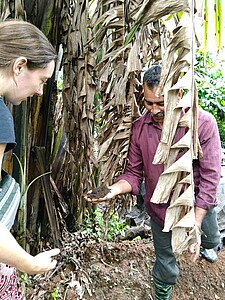
Inspecting soil with Illias, a farmer from Thrissur, who is also the president of the Organic Farming Association of India (OFAI).
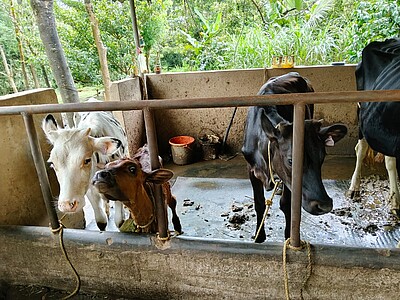
Learning about the smallholder dairy industry in Kerala.

Navya Miriam Itty (Socioecology)

"In September this year, I travelled to Kerala with the team for the scoping phase of our research study. When you grow up in a place for more than half your life, it’s easy to take what you have for granted – the landscape, the biodiversity, the food, the language, the warmth (of both the place and the people) and so much more. This opportunity to be back home in the context of research and the curiosity it demanded enabled me to (re)discover and appreciate so many of these little things that I let go unnoticed.

We interacted with farmers, researchers, and practitioners who brought in a diversity of experiences and perspectives on the vastly changing agrarian landscape in Wayanad. There was inspiration to be found everywhere! These place-based knowledges so generously shared will be invaluable to contextualizing my research focus and questions. On the other (slightly saddening) hand, I found it difficult to grapple with the complex, systemic challenges that are driving farmers and agricultural workers out of farming today. The one thing that has been ringing in my ear since coming back is a question that was posed to me by a farmer – “How can the work you do help us in our fight?”. At present, I’m holding the slight discomfort of reflecting on my positionality as a researcher as well as my responsibility in fostering relationships based on reciprocity. The hurdle I see is finding a way to bring my science back into society; how can my research practice translate into something tangible and/or material on the ground? How can we give back?"

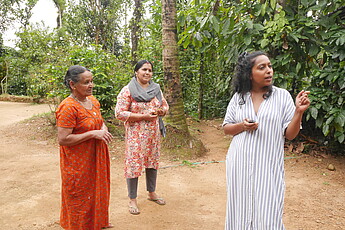
Navya connecting with farmers in rural Wayanad
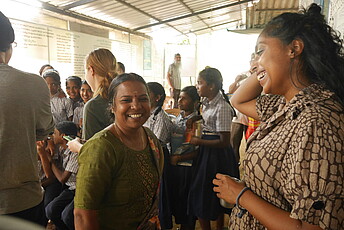
Active engagement with the local farming community during a workshop held by EcoFriends

Bowy den Braber, Postdoc

"I have just returned from a scoping trip for the Bright Futures project in Kerala, India. In this project we aim to learn from exceptional farmers across the world, who found ways to make their farms sustainable for people and biodiversity. Our team (also consisting of Navya Miriam Itty, Hannah Melcher, Hannah Uther, Huei Ying Gan and Ingo Grass) met with collaborators from the Kerala Agricultural University and, most importantly, with farmers in Wayanad, the agricultural hub of Kerala.

Wayanad is one of those bright spots of sustainable agriculture, filled with absolute gems of people. We met the banana man, who as a hobby grows 100 varieties of banana on his farm, conserving genetic diversity for future generations. Or the PhD student who farms on the side because he could not give up his passion, yet still has time to give demonstrations on how to make organic fertilizer.

Wandering through their forest-like farms felt like a dream, but also makes you think. If such bright spots are out there, what am I doing in my office? Working on a project about bright futures sometimes makes you feel delusional in a world that seems determined for darkness. What can a scientist like me do against such powers?

Not much but also not nothing. Maybe this office with TL-lights is my little battlefield. Armed with morning chai, we will navigate through misty papers, defeat reviewer 2, and forge our ideas in the fires of Mt. Scientific Publication. There, we will make our stand to make the world more bright: from spots, to circles, to the globe.

Reporting from Germany, while thinking about Keralan farms. "


Visiting Mr. Nishanth Keloth’s ("banana man") farm
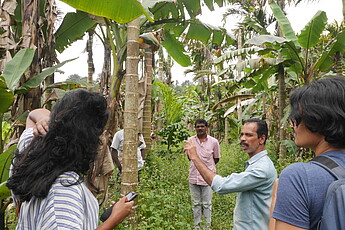
Navigating through the complex agroforest, multicrop farm in Wayanad

In addition to field investigations, the scoping trip also aimed to forge new collaborations and strengthen existing partnerships. As part of this mission, the BRIGHT-Futures team visited Dr. Archana Sathyan and her colleagues at the Kerala Agricultural University (KAU) in Vellayani, southern Kerala. During their stay, the team held and attended multiple meetings and presentations, engaging with faculty members from the Department of Soil Science & Agricultural Chemistry and the Department of Agricultural Entomology.

In total, the team exchanged with academic partners across three KAU campuses (Vellayani, Thrissur, and Wayanad). A key outcome from these official meetings was the drafting of a Memorandum of Understanding (MoU) for cooperation between BRIGHT-Futures and KAU, led by Dr. Archana Sathyan. Preparations are also underway for subcontract agreements (Mittelweiterleitungsvertrag) to support project expenses in Kerala, including sampling, personnel, and operational costs.

During the field component, the team interacted with 18 farmers representing diverse backgrounds and farming practices, including organic and conventional farmers, tribal farmers, women farmers, and members of well-established eco-generative farming networks. They also visited several farmers’ cooperatives and local NGOs, such as: